Monday, October 26, 2015

Henry VII


The face of the Tree-man can now be identified as Henry VII of England, likely based on the portrait in the National Portrait Gallery, London or a copy of it. Another image of Henry VII in the center panel seems to be based on a profile on a coin, likely to represent his penny pinching ways, but the one shown here has him in Rome in 1527, eavesdropping at the wall of a tree-house, in character as a spymaster. The reason he appears in 1527 (when he died in 1509) is most likely that in that year his daughter Margaret, Queen of Scots was divorced and his son Henry VIII was attempting to divorce even though the Pope was on the run from the sack. The enormous portrait is Charles V’s way of telling Henry VIII that his dad would be mad.

Monday, March 23, 2015

Maximilian and Trithemius

Just for the sake of context, the center panel of the Hieronymus Bosch triptych of Saint Anthony in Lisbon appears to come from the general direction of the Holy Roman Emperor Maximilian, a Yorkist, and the idea of demons conveying messages is likely based on the work of the abbot Johannes Trithemius who advised Maximilian on demonology and also devised secret codes. This is not without interest in terms of art history since a comparison to Trithemius’s Steganographia and Polygraphia helps to clarify that for instance the Nahuatl chronology in El Jardin de las Delicias can be seen as an example of a message that can be decoded by putting its elements in chronological order by means of an obscure system, in this case a language that was unknown to most observers. A less obscure example is the series of illustrations described by Laurinda Dixon of an alchemical process for making gold in a laboratory. Charles V had no more need for alchemists than Saint Anthony had for demons volunteering to send messages since he had access to gold from New Spain, and the alchemical stages are certainly partly allegory (with for example the Sack of Rome representing putrefactio), but also a cover text to illustrate Trithemius’s steganography, that is the use of codes that make messages appear to be plain text concerning some unlikely subject.

Friday, March 13, 2015

The pois’nous bunch-back’d toad


Any information conveyed by the demons behind Saint Anthony, who is shown ignoring the lot of them, has to be regarded as unreliable. (I have added some labels to the detail shown here to show who appears to be claiming to be who.) Nonetheless they may have something to contribute to debates around Richard III. If nothing else, Hieronymus Bosch’s painting suggests that Shakespeare’s Margaret of Anjou was repeating a cliché when she slowed down a little after a long string of insults, just enough to allow Richard the Duke of Gloucester to get a word in sideways:
QUEEN MARGARET. And leave out thee? Stay, dog, for thou
    shalt hear me.
    If heaven have any grievous plague in store
    Exceeding those that I can wish upon thee,
    O, let them keep it till thy sins be ripe,
    And then hurl down their indignation
    On thee, the troubler of the poor world's peace!
    The worm of conscience still be-gnaw thy soul!
    Thy friends suspect for traitors while thou liv'st,
    And take deep traitors for thy dearest friends!
    No sleep close up that deadly eye of thine,
    Unless it be while some tormenting dream
    Affrights thee with a hell of ugly devils!
    Thou elvish-mark'd, abortive, rooting hog,
    Thou that wast seal'd in thy nativity
    The slave of nature and the son of hell,
    Thou slander of thy heavy mother's womb,
    Thou loathed issue of thy father's loins,
    Thou rag of honour, thou detested-
  GLOUCESTER. Margaret!
  QUEEN MARGARET. Richard!
  GLOUCESTER. Ha?
  QUEEN MARGARET. I call thee not.
  GLOUCESTER. I cry thee mercy then, for I did think
    That thou hadst call'd me all these bitter names.
  QUEEN MARGARET. Why, so I did, but look'd for no reply.
    O, let me make the period to my curse!
  GLOUCESTER. 'Tis done by me, and ends in-Margaret.
  QUEEN ELIZABETH. Thus have you breath'd your curse
    against yourself.
  QUEEN MARGARET. Poor painted queen, vain flourish of my
    fortune!
    Why strew'st thou sugar on that bottled spider
    Whose deadly web ensnareth thee about?
    Fool, fool! thou whet'st a knife to kill thyself.
    The day will come that thou shalt wish for me
    To help thee curse this poisonous bunch-back'd toad.
  HASTINGS. False-boding woman, end thy frantic curse,
    Lest to thy harm thou move our patience.
  QUEEN MARGARET. Foul shame upon you! you have all
    mov'd mine.
  RIVERS. Were you well serv'd, you would be taught your
      duty.
  QUEEN MARGARET. To serve me well you all should do me
    duty,
    Teach me to be your queen and you my subjects.
    O, serve me well, and teach yourselves that duty!
  DORSET. Dispute not with her; she is lunatic.
  QUEEN MARGARET. Peace, Master Marquis, you are malapert;
    Your fire-new stamp of honour is scarce current.
According to Thomas More, as of June 13, 1483 his left arm had been injured by sorcery that he blamed on Elizabeth, Jane Shore, and unnamed accomplices:
…And all the other affirmed the same. That is (quoth he) yonder sorceress my brother’s wife and other with her, meaning the queen. At these words many of the other Lords were greatly abashed that favoured her. But the lord Hastings was in his mind better content, that it was moved by her, than by any other whom he loved better. Albeit his heart somewhat grudged, that he was not afore made of counsel in this matter, as he was of the taking of her kindred, and of their putting to death, which were by his assent before devised to be beheaded at Pomfret this self same day, in which he was not ware that it was by other devised, that himself should the same day be beheaded at London. Then said the protector; ye shall all see in what wise that sorceress and that other witch of her counsel, Shore’s wife, with their affinity, have by their sorcery and witchcraft wasted my body. And therewith he plucked up his doublet sleeve to his elbow upon his left arm, where he showed a werish arm and small, as it was never other. And thereupon every man’s mind sore misgave them, well perceiving that this matter was but a quarrel. For well they wist, that the queen was too wise to go about any such folly. And also, if she would, yet would she of all folk least make Shore’s wife of counsel, whom of all women she most hated, as that concubine whom the king her husband had most loved. And also no man was there present, but well knew that his harm was ever such since his birth. Natheless the lord Chamberlain answered and said: certainly, my lord, if they have so heinously done, they be worthy heinous punishment. What, quoth the protector, thou servest me, I ween, with ifs and with ans, I tell thee they have so done, and that I will make good on thy body, traitor. And therewith, as in a great anger, he clapped his fist upon the board a great rap. At which token given, one cried treason without the chamber. Therewith a door clapped, and in come there rushing men in harness as many as the chamber might hold. And anon the protector said to the Lord Hastings: I arrest thee, traitor.…
Hieronymus Bosch’s picture of Richard III suggests a recent injury, as though the king formerly could play a lute and now can barely carry it under his arm, and paralysis rather than withering. It is actually consistent with the Society of Antiquaries portrait, which might represent a paralyzed right hand; that is, unless the artist deliberately reversed the National Portrait Gallery version to suggest the king was left-handed, although if he had been left-handed there would likely be some verbal indication somewhere. 
 
If it was a paralysis caused by sorcery, it might have resolved before the Battle of Bosworth two years later, and also might not have left any physical evidence, assuming that anxiety about sorcery could produce a real paralysis but could not deform a person’s bones.
                        The painting suggests that “toad” was a little ambiguous, since toads are sometimes hunchbacked, sometimes associated with witchcraft, and also sometimes poisonous, unless someone put a spell on a poisonous toad, which would have covered all the bases.
                        It also illustrates that Richard III was not a hunchback as the word is mostly understood, and interestingly goes on to represent an actual hunchback as someone who can work as a musician. The real hunchback is quick to help the temporarily afflicted king when he sees the lute about to fall to the pavement.
                        The identification of the dog Lovell is less certain given the absence of the cat and the rat.

Tuesday, February 3, 2015

Michelangelo's cats?

I wonder if these might all be illustrations of the Biblical proverb “the race is not to the swift” along with Titian’s leopards. Maybe people are too quick to assume classical mythology was always meant to be serious.

Also, the inspiration for the bronze cats might have been pairs of African bronze leopards when the Indies included both Africa and South Asia.

The bronzes have just been attributed to Michelangelo and here are some links:

http://www.fitzmuseum.cam.ac.uk/news/archive/article.html?5006
http://www.theguardian.com/artanddesign/2015/feb/02/michelangelo-bronzes-sculptures-fitzwilliam-museum-cambridge
http://www.theguardian.com/artanddesign/gallery/2015/feb/02/michelangelo-bronzes-discovered-in-pictures
http://www.theartnewspaper.com/articles/Two-bronzes-attributed-convincingly-to-Michelangelo/37002
http://artsbeat.blogs.nytimes.com/2015/02/02/two-bronze-sculptures-are-attributed-to-michelangelo/?src=me
http://www.arthistorynews.com/articles/3235_Michelangelo_bronzes_discovered http://www.dailymail.co.uk/news/article-2936919/The-sketches-prove-bronzes-work-Michelangelo-Tiny-500-year-old-drawing-one-artist-s-students-helps-solve-mystery.html?ITO=1490&ns_mchannel=rss&ns_campaign=1490


Thursday, October 16, 2014

Three fragments from Ovid

A Calydonian boar hunt for Katherine of Aragon’s successful campaign against Caledonian invaders (Scots); find the boars, not to be confused with bears. 
Proserpina thinking twice before eating seeds from a pomegranate for the well read child Mary Tudor, taken away from her mother the princess from Granada. 
A Fall of Icarus for Henry VIII’s fall into a river. 
Hopefully these help to establish the date of the triptych. The comparison between Katherine of Aragon combating the Caledonians in the 1513 Battle of Flodden and Atalanta participating in the Calydonian boar hunt might have been made years earlier, but Mary Tudor was not born until 1516 and Henry VIII’s fall in the water was in 1525. It was reenacted in the television series The Tudors, season 1, episode 4.


Friday, June 20, 2014

Henry Tudor in a Hieronymus Bosch Painting

A young Henry Tudor is accompanied by Elizabeth of York. For those of us who have trouble remembering roses they are color coded as Mr. Red and Mrs. White. Henry Tudor is easy to identify but he appears to be confronting a more difficult puzzle. Is the boar-face man Richard III back from the dead? Or the hunchback? But meanwhile obviously the whole drama is only the kind of thing Saint Anthony was able to resist watching.


Tuesday, July 9, 2013

Giovanni da Udine was the artist (along with assistants and advisors)


No time for details but a match to an elephant and giraffe in the Stufetta of Cardinal Bibbiena in the Vatican means the circumstantial case against Giovanni da Udine as the author of The Garden of Earthly Delights/El Jardín de las Delicias (against since he seems to have wanted to stay anonymous) is much easier to make than it would be otherwise. Not surprisingly the elephant’s name Anonne (Hanno in English) is a pun on Anonimo or Anonymous.
                        The photograph is a detail from Nicole Dacos and Caterina Furlan, Giovanni da Udine 1487-1561 (1987), page 45, “Giovanni da Udine, Volta della Loggetta del cardinale Bibbiena, particolare. Città del Vaticano.

Thursday, February 14, 2013

La Banidad del Mundo


Is there an easy explanation for the trouble art historians have trying to explain The Garden of Earthly Delights/El Jardín de las Delicias? Its main subject is the book of Ecclesiastes (La Bariedad del Mundo in an old inventory, likely a joke since banidad/vanitas usually applied to simpler pictures) and in particular how the book of Ecclesiastes applies to Henry VIII and his attempts to annul his marriage to Katherine of Aragon, his first wife.

{9:9} Perfruere vita cum uxore, quam diligis, cunctis diebus vitæ instabilitatis tuæ, qui dati sunt tibi sub sole omni tempore vanitatis tuæ: hæc est enim pars in vita, et in labore tuo, quo laboras sub sole.

{9:9} Enjoy life with the wife whom you love, all the days of your uncertain life which have been given to you under the sun, during all the time of your vanity. For this is your portion in life and in your labor, with which you labor under the sun.

From an Anglocentric perspective (and disregarding the massive quantity of Spanish humanist multilingual puzzles including the Nahuatl chronology), the triptych is filled with innuendo directed against Henry VIII and England, including most obviously the man who fell in the river and got his head stuck in the mud. He is not really identifiable but as far as I know there is no other famous person who fell in a river and got his head stuck in the mud. There are also what might be pictures of the same woman in compromising settings with two different men, unless following rumors there are two sisters with uncertain reputations. The innuendo stretches back into the fifteenth century, for instance with Richard III’s white boar (ruddy from being out in the sun) which seems to be carrying an injured bird and a healthy one—the two princes in the tower, one of whom might according to rumor have survived? The imitation Hieronymus Bosch style might refer back to lost paintings by Hieronymus Bosch himself for Philip the Handsome, Charles V’s father, known to have commissioned at least a Last Judgment from Hieronymus Bosch, who along with Charles V’s grandfather Maximilian never met a potential English usurper he didn’t like.


All of this may have been a source of great perplexity for art historians only because art history mostly looks at Catholic and Protestant art, and perhaps because of the innuendo directed against Henry VIII and his predecessors, so it seems to need to be clarified that although it may not be much of a focus in Catholic schools, the divorce is studied in some detail in Anglican and Episcopalian Sunday school, and Charles V’s objections to the divorce are not out of place in a church that still opposes divorce.


Monday, November 19, 2012

Paintings by Pieter Bruegel the Elder

I think each of these picture was painted by Pieter Bruegel the Elder. Just saying.

Monday, October 15, 2012

This is not by Leonardo (continued) or champ fleury versus desert


But still, why make fun of Leonardo da Vinci just because his caption on a drawing was a little imprecise? The problem may have been that another favorite of François I was Geoffroy Tory, who wrote a book on typography, Champ Fleury, in 1529 and then in 1530 became the French king’s publisher, and who was an admirer of Leonardo da Vinci. Did he get the job for his Leonardo da Vinci imitations? His versions of the Vitruvian man were the ones more people would see (even though the Leonardo da Vinci one is more famous now) because they were in a printed book, and they are definitely creepy. The man in the letter “O” is way too much like an execution scene. The Vitruvian man in the tapestry may be hiding in an ink bottle.
Geoffroy Tory’s book also talked about making letters that represent numbers look like pictures of people, which was more in tune with the decorative numbers in some old handwritten manuscripts, from before the invention of printing. In The Garden of Delights/El Jardín de las Delicias, Adam, the Creator, and Eve form a Roman numeral VI standing for the sixth day of creation and 6-flint/tecpatl, sadly backwards in the tapestry. In the Nahuatl chronology, fingers stand for numbers in several places and two people’s hands with five fingers each, forming an X, stand for the number ten, as in 10-flint/tecpatl. (Happy people, in a swimming pool.) It seems that part of the reason the Nahuatl date signs do not look like real ones is that they are partly made to be improvements on Geoffroy Tory’s typography. (Few would argue today that Geoffroy Tory was a better designer than the Italian Aldus Manutius.)
But what does this have to do with Saint Anthony in the desert, the subject of the tapestry? The book about the life of Saint Anthony by Saint Athanasius is cited in virtually everything that has been written about the painting, but it appears that no art historian has ever read it. (The footnotes with editions and page numbers appear to come from research on another artist, Schongauer, and his famous print of Saint Anthony carried up in the air by devils.) But Athanasius insisted that Anthony took a dislike to reading as a child and memorized the Scriptures instead, just by listening carefully to people. The person in the right panel of the Lisbon triptych is Athanasius, who had a beard and always carried a book, and he is there because he is the writer who transmitted the story about Saint Anthony that is shown in the left panel, along with everything else that is known about Saint Anthony.
Saint Anthony was in the desert to get away from a lot of things including books, but it was the Egyptian desert so there were hieroglyphics. One that appears both in the Bosch triptych and in The Garden of Delights/El Jardín de las Delicias is Horapollo’s fish eating fish. It is not in the Saint Anthony tapestry but the tapestry does seem to include a fish eating a person and a person who has caught a fish, and the implication is unclear. Maybe the saint was not preoccupied with "the lawless or abominable" (which was what Horapollo said a fish represented because fish eat fish) or not interested in Egyptian hieroglypics any more than in Latin writing, or maybe the saints and the artists who designed the tapestry knew that Horapollo’s hieroglypics were not real ones. Maybe Hieronymus Bosch thought Horapollo’s hieroglyphics were devils that annoyed the saint.
This leads back to possibly the most interesting thing about all the “Bosch” pictures and the tapestries, which is that they may demonstrate a level of interest in and possibly knowledge of how to interpret hieroglyphs that is not recorded anywhere else. I think it is implied by the fact that Peter Martyr in his Opera Omnia never discussed Egyptian hieroglyphics or Nahuatl hieroglyphics, even though he described Maya writing a little bit. Comparing the omissions in two areas of interest is a little like dividing by zero, but it seems unlikely that he did not notice the similarities in the two writing systems. It might also be that whatever was known about either Nahuatl or Egyptian hieroglyphics may have been regarded as confidential, not for publication. A dozen or so years later the Codex Mendoza included a proper legal certification of the accuracy of its translation and fell into the hands of French pirates, but there was no published handbook for deciphering Nahuatl documents.
Geoffroy Tory’s book title Champ Fleury literally means a field of flowers, so Saint Anthony’s desert was a likely place to put it so long as it was personified by one of the devils bothering the saint. On the other hand, “desert” can sometimes just mean a deserted place and so a desert might be a place with nothing but flowery fields. The word did not always imply that a place was dry. So champ fleury could equal desert.

Sunday, October 7, 2012

This is not by Leonardo or VITRUVIAN MAN AND THE FEATHERLESS BIPED


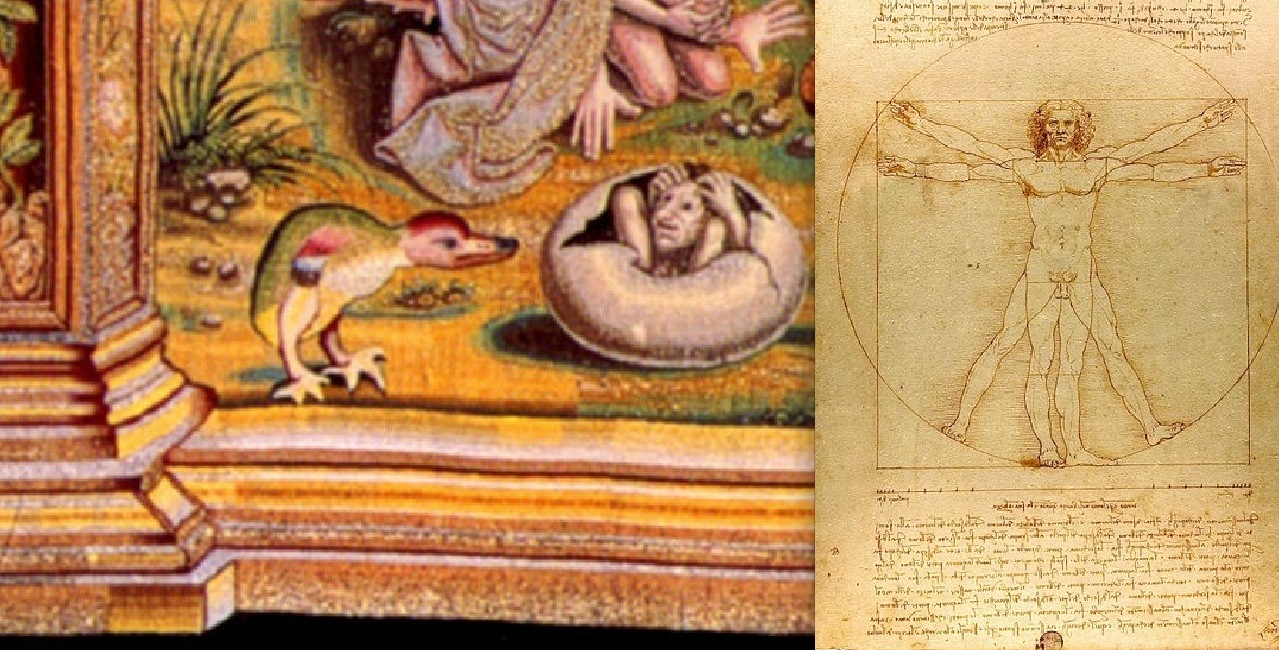
I suspect that the Saint Anthony tapestry was mostly designed by the Pieter Coecke van Aelst workshop and not the Raphael workshop since the Roman ruin in the background is a terribly callous way to allude to the 1527 Sack of Rome which must have caused untold destruction among Raphael’s circle. But it seems likely they helped out with the man in a shell near the lower left corner.


The best explanation for an illustration in the tapestry of Leonardo da Vinci’s caption on the famous Vitruvian Man drawing seems to be Vasari’s claim that there were 50 people milling around the Stanza della Segnatura while Raphael and assistants worked on the famous fresco of the School of Athens. Leonardo’s caption was 1) on an unpublished drawing, 2) in Italian, and 3) backwards in “mirror writing,” and 4) it suggested a hilarious way to misread Vitruvius. The 50 (all or mostly) Italian persons could have included serious scholars, child apprentices, and persons preoccupied with rivaling Leonardo and Michelangelo.

A translation of the second paragraph of the caption on Leonardo’s famous drawing, just above the man’s head, reads

 “if you open your legs enough that your head is lowered by one-fourteenth of your height and raise your hands enough that your extended fingers touch the line of the top of your head, know that the centre of the extended limbs will be the navel, and the space between the legs will be an equilateral triangle”

and fits the person in a shell in the tapestry as well as it does the famous Vitruvian Man in the drawing. It is similar to innumerable sight gags mocking Leonardo in The Garden of Delights/El Jardín de las Delicias, for instance the suggestion that horses are interesting to paint if they are red, white, and blue. The political point was that François I, king of France, was proud of his Leonardo paintings.

The point of the imitation Vitruvian man might be that it is not at all easy to reconstruct Roman architecture based on the Ten Books of Architecture/De Architectura even with the wonderful new editions with woodcut illustrations. The Raphael workshop had faced a similar problem working on the School of Athens, an enormous group portrait, with only some books and old portraits for guidance, and 50 people in the room.

Next to the Vitruvian man in the tapestry and much less obscure is an illustration of another ancient oversimplified definition of a man, the famous “featherless biped” of Plato that Diogenes proposed could just as well be a plucked chicken. The story came from Diogenes Laertius:

“Plato had defined Man as an animal, biped and featherless, and was applauded. Diogenes plucked a fowl and brought it into the lecture-room with the words, ‘Here is Plato’s man.’ In consequence of which there was added to the definition, ‘having broad nails.’” (Lives and Opinions of Eminent Philosophers in Ten Books, Book VI, 40, page 43 of the Loeb Classics edition, vol. II)

It might be that in the School of Athens, Raphael meant to represent the incident by showing Diogenes sprawled on the floor with bare feet, as though his toenails had caught Plato’s eye.

The tapestries were more or less Bosch imitations albeit with mostly new material, and there are innumerable featherless bipeds in Hieronymus Bosch-style paintings. One in the Lisbon Saint Anthony tryptich (likely actually by Bosch since there are so many copies) illustrated the “broad nails” with hooves on what is more or less a dog with two horse’s legs and wings big ears. (I have no explanation for the wings big ears etc.)

The featherless biped in a Prado Saint Anthony (Las tentaciones de San Antonio Abad, Num. de catálogo P02049) is vastly more attractive and is a little like the one in the tapestry but with human feet. Looking closely at this painting with the help of the museum’s Galería Online, I am starting to think it could really be the work of Pieter Bruegel the Elder. He was said to have studied with Pieter Coecke van Aelst and the tapestries are filled with odds and ends that are almost like Bruegel but seldom as good as Bruegel (maybe with the exception of the featherless biped shown here), and he would have been a small child when they were made. The most extraordinary improvement on a theme from the tapestries is the newly restored El vino de la fiesta de San Martín. The small painting of Saint Anthony is vastly harder to recognize as a Bruegel but that may be what it is. I think it is my favorite picture.

Wednesday, August 29, 2012

Ernst Gombrich, “The Earliest Description of Bosch’s Garden of Delight,” JWCI 30 (1967), 403-6, or how the triptych looked a dozen years before it was painted

In honor of the upcoming Hieronymus Bosch conference, here’s what it’s all based on, or at least what the attribution of The Garden of Delights/El Jardín de las Delicias to Hieronymus Bosch is based on. Gombrich (whose dissertation was on a Raphael associate) and Steppe (a tapestry expert) both pointed attention away from the Raphael tapestries that were the biggest show in town.

Wednesday, June 20, 2012

How to Spot a Raphael

Here is a fun link from Bendor Grosvenor to a London National Gallery web page. I think that in their picture of Eve the Raphael workshop were trying to imitate the lost tapestry cartoon by Leonardo. But it looks as though it was Raphael who showed them how to paint pretty eyes.
    Note on method: Morellian details can sometimes point to student work.

Sunday, February 26, 2012

Raphael workshop/taller de Rafael


The current hypothesis is that the triptych in the Museo del Prado is based on the design for one of the tapestries in the style of El Bosco, was probably painted in 1530 or shortly before, and is best attributed to the Raphael workshop/taller de Rafael. It appears as though asked to illustrate the possible confusion of stories about St. George and St. Ursula with an allegory involving the constellations Draco and Ursa Minor, they came up with an improved version of Raphael’s St. George, whose arms were missing in the original painting. They added arms and subtracted the armor.

Here is the context. The Spanish infanta Catalina, Katherine of Aragon, who was well educated in Latin and spoke no English, might have been perplexed by a performance put on as part of the celebrations for her wedding in 1501 to England’s Arthur, Prince of Wales. It had something to do with two patron saints of England, St. George who killed a dragon and St. Ursula whose name means little bear, but knowing Latin and not English the infanta might have thought they were talking about astronomy and the adjacent constellations Draco (Dragon) and Ursa Minor, although to be fair she probably knew perfectly well that Sts. George and Ursula were patron saints of England. By the time the tapestries were made she also knew English.

Thursday, June 23, 2011

Medical advice for gout sufferers in The Garden of Delights/El Jardín de las Delicias


New outside evidence* that Charles V was suffering from gout raises the medical question of whether the health regimen illustrated in The Garden of Delights/El Jardín de las Delicias is medically advisable. Did Philip II (assuming he suffered from the same condition) live longer because he heeded advice to exercise outdoors and avoid eating fish? The diagnosis helps to explain some of the oddest things about the triptych including the thin people in the center panel, the oversize fish and fruit and even the thistle plant in the center; why Philip II kept it; why its meaning became obscure; and why some observers dislike it. The diagnosis of gout resolves all sorts of art historical questions but raises a medical question of whether the lifestyle shown in the painting is something to imitate or not.

Art historically, the diagnosis makes it easy to trace at least some of the triptych’s enigmatic images from their source in an older Hieronymus Bosch triptych to their disappearance in the written record:

1) Images of oversize strawberries and fish (foods for a gout sufferer to avoid), a thistle, and some skinny people clowning around under a table can be seen in Hieronymus Bosch’s triptych of the Temptations of Saint Anthony, which was apparently well known since it was widely copied (although often without the people under the table).

2) The Garden of Delights/El Jardín de las Delicias, painted for Charles V, includes the same images in a more logical setting, since the fish and strawberries in the triptych of the Temptations of Saint Anthony could not have existed in the desert. The oversize fish and fruits represent things not to eat, or not to eat much of. A sardine is to be regarded as a very large fish, and a person is shown becoming sick from eating a small amount of a very large strawberry. There is a thistle, sometimes cited as a remedy for gout, near the center of the center panel.

3) Charles V’s court was peripatetic, and carrying around a large illustration of things not to eat might not have endeared him to his hosts in one city after another. He appears to have left The Garden of Delights/El Jardín de las Delicias with a member of his entourage, Hendrick III of Nassau. It may have been a political liability, analogous to the written requests for a certain type of bottled water that sometimes surface to embarrass politicians and rock stars today.

4) Philip II, who stayed in one place, also suffered from gout, and his liking The Garden of Delights/El Jardín de las Delicias has puzzled art historians for a long time. But he is on record as saying he never ate fish, and at least in later years as actually not having fish on the menu, and for saying the best thing to do for gout was to exercise outdoors and avoid physicians. The record on fruit is ambiguous, and might have to do with avoiding some fruits but not others.**

5) José de Sigüenza’s comments on The Garden of Delights/El Jardín de las Delicias include Philip II’s saying it was not heretical and an explanation of its old title as having to do with the vanity and brief taste and aroma of strawberries or madroños (“la otra tabla, de la gloria vana y breve gusto de la fresa o madroño y su olorcillo que apenas se siente cuando ya es pasado”). A likely explanation is that Sigüenza had in mind a general audience for whom fruit was not something to try to avoid. Eating or not eating strawberries is not an important thing to most people and thus can stand as an example of vanitas. A longer explanation would have meant reiterating the history of the king’s illness which ended with severe infections.

6) A fairly large proportion of the commentary on The Garden of Delights/El Jardín de las Delicias has to do with what seems like the peculiar, unconventional, and to some observers perverse conduct of the people shown in the center panel. This can be at least partially explained by the strangeness of recommended regimens for gout sufferers, which involve not eating specific foods, and not eating much overall. Foods that are good for everyone else are off limits to the person trying to lessen the severity of gout attacks. In the weird and disagreeable predicament of a person diagnosed with gout, it is healthier to be like the people in old, medieval paintings with their exaggeratedly thin legs and feet, and less healthy to be like the sturdy figures who populate most 16th century art. From the gout sufferer’s perspective, the pointed toes that look silly to art critics might look cheerful. The medieval look might represent a fantasy of bygone times when gout was not so widespread.

*A team of physicians have definitely established that their 16th century predecessors were not mistaken and the illness that afflicted Charles V was definitely gout. A 2006 article in the New England Journal of Medicine by Jaume Ordi, MD et al. details their analysis of part of the emperor’s finger which had become mummified and was kept separately in the sacristy in the Escorial, where they found the characteristic lumps (“massive gouty tophi”) and urate crystals that go along with the disease.

** See Henry Kamen, Philip of Spain (1997).

note: The medical advice described here and the Nahuatl chronology described in earlier posts are both part of the overall commentary on Ecclesiastes that is the main subject of the triptych.

Friday, December 10, 2010

The Race is not to the Swift


The circle of riders in the center of the triptych represents just part of a verse from Ecclesiastes:

9:11 I turned myself toward another thing, and I saw that under the sun, the race is not to the swift, nor the battle to the strong, nor bread to the wise, nor wealth to the learned, nor grace to the skilful: but there is a time and an end for all these things. (Verti me ad aliud, et vidi sub sole, nec velocium esse cursum, nec fortium bellum, nec sapientium panem, nec doctorum divitias, nec artificum gratiam: sed tempus, casumque in omnibus.)

How many ways are there for a swift animal and rider to lose a race? Starting at the lower left, an animal and rider could be looking up at something distracting, and the goat in front of them could be distracted by birds making noise. Every contestant in the whole circle seems to have a different problem.

The circle of riders appears to be the password for unlocking the rest of the triptych, even though I have found it fairly late in the game, after deciphering the inside and outside panels in some detail and identifying the overall subject as the book of Ecclesiastes. A more alert interpreter might have seen that all of the riders and animals were showing different ways to lose a race, remembered the part of a line from Ecclesiastes, and proceeded from there. Different interpreters might come up with different numbers if the question were about exactly how many ways to lose a race are shown in the picture, but there seem to be enough examples to make it clear that “the race is not to the swift” is the answer to a puzzle. This one extremely redundant example demonstrates how the rest of the puzzles are to be solved, by guessing the answer and then finding more detail or context based on the answer, or new questions. For José de Sigüenza the next step was to identify the vices symbolized by each animal, but for this interpretation it will be to continue with the project of establishing that the triptych dates from 1528 or later and show how it relates to more news-like events and issues, even though Sigüenza may have been right in suggesting that casting blame is a major theme in the triptych.

Thursday, September 30, 2010

Henry VIII, main part of the triptych


Once the Nahuatl chronology is in place and the king and island on the outside are shown to relate to Henry VIII and his situation as of 1528, interpreting the central panels is amazingly easy. The three main topics in the triptych are the conquest of Mexico, shown year by year in annals style and in hieroglyphics, problems with Martin Luther, shown in an equally obscure fashion, and Henry VIII's pending divorce, which is shown as a matter of big, simple issues that do not go away.
To start with, the left panel shows Adam and Eve, with no replacement in case Adam wants to try again with another woman. On the other hand, the right panel shows the sack of Rome (labeled in the Nahuatl chronology as happening in 1527) which would continue to affect the divorce one way or the other.
The most obvious divorce-related image in the center panel is the scene showing a woman inside a sphere, where the man outside the sphere cannot see another man who is inside the sphere with her. Was Katherine of Aragon's marriage with the king's older brother consummated? Who knows.
Artistically, the late Hieronymus Bosch (who died in 1516) is less important than the Franciscan Thomas Murner, who had a system of teaching based on sets of pictures, sometimes playing cards. The idea was that pupils could connect words to pictures of things they liked (horses, spiders, scorpions) and also remember larger, complicated pictures. Like the "new math" of the 1960s, it made no sense to anyone but the pupils, which may have made it more effective. Murner was also the one to translate Henry VIII's book into German. The humorous side that José de Sigüenza called macaronic seems to derive more from the late Peter Martyr who was Katherine of Aragon's tutor, and the late Antonio de Nebrija.
The present interpretation has been going along CSI-style, starting with the iconographic equivalent of looking at footprints under a microscope, but like a CSI mystery, it is revolving into a situation where some of the most implausible or fragmentary early interpretations turn out to be correct. These include:
  • Paul Vandenbroek's 1000-page explanation of how (paraphrasing very loosely) the center panel shows marriage as boring but necessary;
  • Isabel Mateo Gomez's identification of the person at the lower right as John the Baptist (since he was beheaded for objecting to a case of bigamy);
  • Derek Wilson's identification of the skull in Holbein's Ambassadors as a pun where memento mori stands for memento (Thomas More)i;
  • the anonymous French inventory that described a tapestry version as follows: "…Une aultre pièce en laquelle est figuré le Monde, l'Enfer et le Paradis terrestre, enchassé en ung tableau contrefaict de menuyserie comme les précédans, sauf qu'il y a deux colonnes par voye…" The two columns made it absurdly obvious that it showed Charles V's view of the world. The associated motto "plus ultra" (farther out) applies fairly well to the process of interpreting the very complicated picture.
Also, to add something new, the fish in the center has to represent John Fisher. Saint Thomas More and Saint John Fisher, both shown as important here, were canonized later.
The artist is still unidentified but it is starting to look as though the triptych went to Breda with Hendrick III of Nassau (as various scholars claim) rather than his wife Mencía de Mendoza since Hendrick was a crony of Charles V and seems to have had more of a sense of humor than his more literate wife.
For those who long for CSI type evidence, the paw of the lizard that was discovered when the right panel was x-rayed has a remarkable resemblance to the hand of a small boy in a tapestry that was made for Hendrick III, based on a design by Raphael and Giovanni da Udine but more ridiculous than the average Raphael.

Monday, December 7, 2009

Henry VIII


The picture on the outside panels is based on an illustration in the Nuremberg Chronicle (1493), with several changes.

Subtractions include:
1) the bambini at the top building a tabernacle from cut branches
2) the crystal orb representing the earth
3) the two columns at the sides, which since about 1516 had been a personal emblem of Charles V
4) the blank shields that could be filled in by the owner of a copy of the book.

Additions include:
1) a pope's crown
2) a book
3) a circular island, resembling the map in Thomas More's Utopia.

These are updates: around 1528, against the advice of Thomas More, the island king Henry VIII, who had written a book that was well received by the pope, was on the way to divorcing the queen and breaking with the Catholic Church.

The circa 1528 date comes from the allegorized Nahuatl picture writing on the inside panels, but perhaps the English connection is enough to suggest an approximate date on its own, at least to a time window when the king's decision was still up in the air.

added note: An object on the throne in the Nuremberg Chronicle illustration might be a book, but it is more prominent and recognizable on the triptych.