Monday, November 19, 2012
Paintings by Pieter Bruegel the Elder

Monday, October 15, 2012
This is not by Leonardo (continued) or champ fleury versus desert


But
still, why make fun of Leonardo da Vinci just because his caption on a drawing
was a little imprecise? The problem may have been that another favorite of
François I was Geoffroy Tory, who wrote a book on typography, Champ Fleury, in
1529 and then in 1530 became the French king’s publisher, and who was an
admirer of Leonardo da Vinci. Did he get the job for his Leonardo da Vinci
imitations? His versions of the Vitruvian man were the ones more people would
see (even though the Leonardo da Vinci one is more famous now) because they
were in a printed book, and they are definitely creepy. The man in the letter
“O” is way too much like an execution scene. The Vitruvian man in the tapestry
may be hiding in an ink bottle.
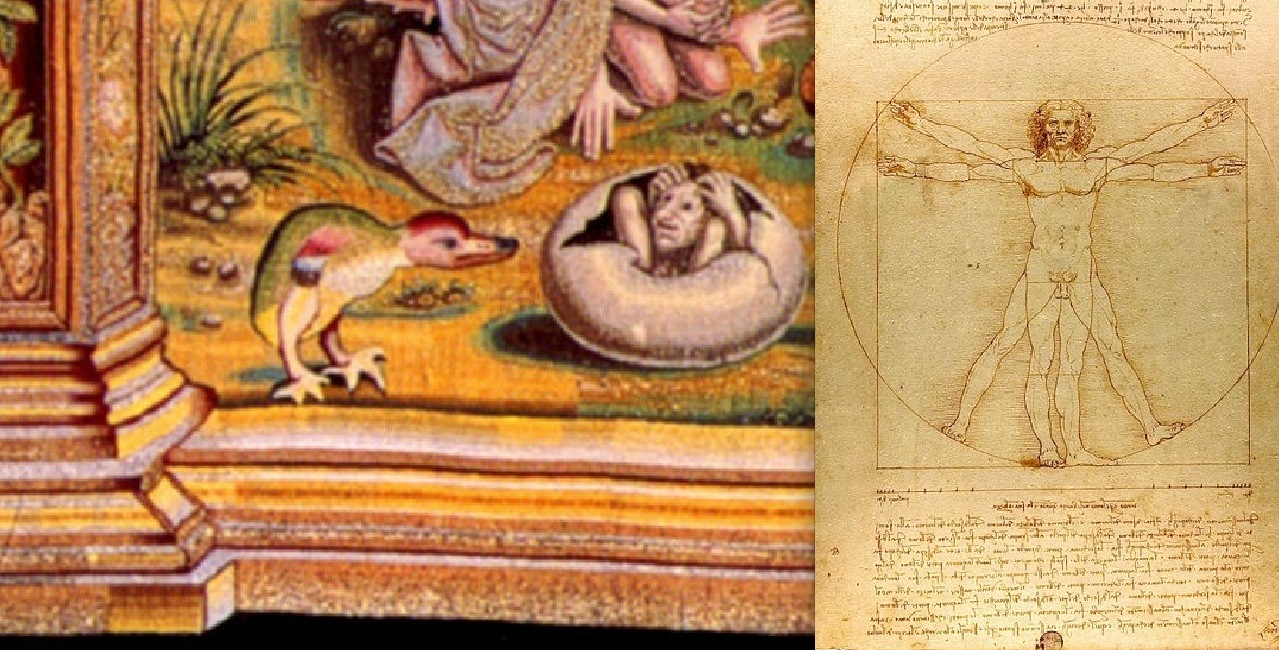
 Geoffroy
Tory’s book also talked about making letters that represent numbers look like
pictures of people, which was more in tune with the decorative numbers in some
old handwritten manuscripts, from before the invention of printing. In The
Garden of Delights/El Jardín de las Delicias, Adam, the Creator, and Eve form a
Roman numeral VI standing for the sixth day of creation and 6-flint/tecpatl,
sadly backwards in the tapestry. In the Nahuatl chronology, fingers stand for
numbers in several places and two people’s hands with five fingers each,
forming an X, stand for the number ten, as in 10-flint/tecpatl. (Happy people,
in a swimming pool.) It seems that part of the reason the Nahuatl date signs do
not look like real ones is that they are partly made to be improvements on
Geoffroy Tory’s typography. (Few would argue today that Geoffroy Tory was a better
designer than the Italian Aldus Manutius.)
Geoffroy
Tory’s book also talked about making letters that represent numbers look like
pictures of people, which was more in tune with the decorative numbers in some
old handwritten manuscripts, from before the invention of printing. In The
Garden of Delights/El Jardín de las Delicias, Adam, the Creator, and Eve form a
Roman numeral VI standing for the sixth day of creation and 6-flint/tecpatl,
sadly backwards in the tapestry. In the Nahuatl chronology, fingers stand for
numbers in several places and two people’s hands with five fingers each,
forming an X, stand for the number ten, as in 10-flint/tecpatl. (Happy people,
in a swimming pool.) It seems that part of the reason the Nahuatl date signs do
not look like real ones is that they are partly made to be improvements on
Geoffroy Tory’s typography. (Few would argue today that Geoffroy Tory was a better
designer than the Italian Aldus Manutius.) But
what does this have to do with Saint Anthony in the desert, the subject of the
tapestry? The book about the life of Saint Anthony by Saint Athanasius is cited
in virtually everything that has been written about the painting, but it
appears that no art historian has ever read it. (The footnotes with editions
and page numbers appear to come from research on another artist, Schongauer,
and his famous print of Saint Anthony carried up in the air by devils.) But
Athanasius insisted that Anthony took a dislike to reading as a child and
memorized the Scriptures instead, just by listening carefully to people. The
person in the right panel of the Lisbon triptych is Athanasius, who had a beard
and always carried a book, and he is there because he is the writer who
transmitted the story about Saint Anthony that is shown in the left panel,
along with everything else that is known about Saint Anthony.
But
what does this have to do with Saint Anthony in the desert, the subject of the
tapestry? The book about the life of Saint Anthony by Saint Athanasius is cited
in virtually everything that has been written about the painting, but it
appears that no art historian has ever read it. (The footnotes with editions
and page numbers appear to come from research on another artist, Schongauer,
and his famous print of Saint Anthony carried up in the air by devils.) But
Athanasius insisted that Anthony took a dislike to reading as a child and
memorized the Scriptures instead, just by listening carefully to people. The
person in the right panel of the Lisbon triptych is Athanasius, who had a beard
and always carried a book, and he is there because he is the writer who
transmitted the story about Saint Anthony that is shown in the left panel,
along with everything else that is known about Saint Anthony.
Saint
Anthony was in the desert to get away from a lot of things including books, but
it was the Egyptian desert so there were hieroglyphics. One that appears both
in the Bosch triptych and in The Garden of Delights/El Jardín de las Delicias
is Horapollo’s fish eating fish. It is not in the Saint Anthony tapestry but the
tapestry does seem to include a fish eating a person and a person who has
caught a fish, and the implication is unclear. Maybe the saint was not
preoccupied with "the lawless or abominable" (which was what Horapollo said a fish
represented because fish eat fish) or not interested in Egyptian hieroglypics any more than in Latin
writing, or maybe the saints and the artists who designed the tapestry knew
that Horapollo’s hieroglypics were not real ones. Maybe Hieronymus Bosch
thought Horapollo’s hieroglyphics were devils that annoyed the saint.

This
leads back to possibly the most interesting thing about all the “Bosch”
pictures and the tapestries, which is that they may demonstrate a level of
interest in and possibly knowledge of how to interpret hieroglyphs that is not
recorded anywhere else. I think it is implied by the fact that Peter Martyr in
his Opera Omnia never discussed Egyptian hieroglyphics or Nahuatl
hieroglyphics, even though he described Maya writing a little bit. Comparing
the omissions in two areas of interest is a little like dividing by zero, but it seems
unlikely that he did not notice the similarities in the two writing systems. It
might also be that whatever was known about either Nahuatl or Egyptian
hieroglyphics may have been regarded as confidential, not for publication. A
dozen or so years later the Codex Mendoza included a proper legal certification
of the accuracy of its translation and fell into the hands of French pirates,
but there was no published handbook for deciphering Nahuatl documents.
Geoffroy
Tory’s book title Champ Fleury literally means a field of flowers, so Saint
Anthony’s desert was a likely place to put it so long as it was personified by
one of the devils bothering the saint. On the other hand, “desert” can
sometimes just mean a deserted place and so a desert might be a place with
nothing but flowery fields. The word did not always imply that a place was dry.
So champ fleury could equal desert.
Sunday, October 7, 2012
This is not by Leonardo or VITRUVIAN MAN AND THE FEATHERLESS BIPED

The
best explanation for an illustration in the tapestry of Leonardo da Vinci’s
caption on the famous Vitruvian Man drawing seems to be Vasari’s claim that
there were 50 people milling around the Stanza della Segnatura while Raphael and
assistants worked on the famous fresco of the School of Athens. Leonardo’s
caption was 1) on an unpublished drawing, 2) in Italian, and 3) backwards in
“mirror writing,” and 4) it suggested a hilarious way to misread Vitruvius. The
50 (all or mostly) Italian persons could have included serious scholars, child
apprentices, and persons preoccupied with rivaling Leonardo and Michelangelo.
A
translation of the second paragraph of the caption on Leonardo’s famous
drawing, just above the man’s head, reads
“if you open your legs enough that your head is lowered by one-fourteenth of your height and raise your hands enough that your extended fingers touch the line of the top of your head, know that the centre of the extended limbs will be the navel, and the space between the legs will be an equilateral triangle”
and
fits the person in a shell in the tapestry as well as it does the famous
Vitruvian Man in the drawing. It is similar to innumerable sight gags mocking
Leonardo in The Garden of Delights/El Jardín de las Delicias, for instance the
suggestion that horses are interesting to paint if they are red, white, and
blue. The political point was that François I, king of France, was proud of his
Leonardo paintings.
The
point of the imitation Vitruvian man might be that it is not at all easy to
reconstruct Roman architecture based on the Ten Books of Architecture/De
Architectura even with the wonderful new editions with woodcut illustrations.
The Raphael workshop had faced a similar problem working on the School of
Athens, an enormous group portrait, with only some books and old portraits for
guidance, and 50 people in the room.
Next
to the Vitruvian man in the tapestry and much less obscure is an illustration
of another ancient oversimplified definition of a man, the famous “featherless
biped” of Plato that Diogenes proposed could just as well be a plucked chicken.
The story came from Diogenes Laertius:
“Plato had defined Man as an animal, biped and featherless, and was applauded. Diogenes plucked a fowl and brought it into the lecture-room with the words, ‘Here is Plato’s man.’ In consequence of which there was added to the definition, ‘having broad nails.’” (Lives and Opinions of Eminent Philosophers in Ten Books, Book VI, 40, page 43 of the Loeb Classics edition, vol. II)

It
might be that in the School of Athens, Raphael meant to represent the incident
by showing Diogenes sprawled on the floor with bare feet, as though his
toenails had caught Plato’s eye.

The
tapestries were more or less Bosch imitations albeit with mostly new material,
and there are innumerable featherless bipeds in Hieronymus Bosch-style
paintings. One in the Lisbon Saint Anthony tryptich (likely actually by Bosch
since there are so many copies) illustrated the “broad nails” with hooves on
what is more or less a dog with two horse’s legs and wings big ears. (I have no
explanation for the wings big ears etc.)

The
featherless biped in a Prado Saint Anthony (Las tentaciones de San Antonio
Abad, Num. de catálogo P02049) is vastly more attractive and is a little like
the one in the tapestry but with human feet. Looking closely at this painting
with the help of the museum’s Galería Online, I am starting to think it could
really be the work of Pieter Bruegel the Elder. He was said to have studied
with Pieter Coecke van Aelst and the tapestries are filled with odds and ends
that are almost like Bruegel but seldom as good as Bruegel (maybe with the
exception of the featherless biped shown here), and he would have been a small
child when they were made. The most extraordinary improvement on a theme from
the tapestries is the newly restored El vino de la fiesta de San Martín. The small painting
of Saint Anthony is vastly harder to recognize as a Bruegel but that may be
what it is. I think it is my favorite picture.

Wednesday, August 29, 2012
Ernst Gombrich, “The Earliest Description of Bosch’s Garden of Delight,” JWCI 30 (1967), 403-6, or how the triptych looked a dozen years before it was painted

Wednesday, June 20, 2012
How to Spot a Raphael

Note on method: Morellian details can sometimes point to student work.
Sunday, February 26, 2012
Raphael workshop/taller de Rafael

The current hypothesis is that the triptych in the Museo del Prado is based on the design for one of the tapestries in the style of El Bosco, was probably painted in 1530 or shortly before, and is best attributed to the Raphael workshop/taller de Rafael. It appears as though asked to illustrate the possible confusion of stories about St. George and St. Ursula with an allegory involving the constellations Draco and Ursa Minor, they came up with an improved version of Raphael’s St. George, whose arms were missing in the original painting. They added arms and subtracted the armor.
Here is the context. The Spanish infanta Catalina, Katherine of Aragon, who was well educated in Latin and spoke no English, might have been perplexed by a performance put on as part of the celebrations for her wedding in 1501 to England’s Arthur, Prince of Wales. It had something to do with two patron saints of England, St. George who killed a dragon and St. Ursula whose name means little bear, but knowing Latin and not English the infanta might have thought they were talking about astronomy and the adjacent constellations Draco (Dragon) and Ursa Minor, although to be fair she probably knew perfectly well that Sts. George and Ursula were patron saints of England. By the time the tapestries were made she also knew English.
Thursday, June 23, 2011
Medical advice for gout sufferers in The Garden of Delights/El Jardín de las Delicias

New outside evidence* that Charles V was suffering from gout raises the medical question of whether the health regimen illustrated in The Garden of Delights/El Jardín de las Delicias is medically advisable. Did Philip II (assuming he suffered from the same condition) live longer because he heeded advice to exercise outdoors and avoid eating fish? The diagnosis helps to explain some of the oddest things about the triptych including the thin people in the center panel, the oversize fish and fruit and even the thistle plant in the center; why Philip II kept it; why its meaning became obscure; and why some observers dislike it. The diagnosis of gout resolves all sorts of art historical questions but raises a medical question of whether the lifestyle shown in the painting is something to imitate or not.

Art historically, the diagnosis makes it easy to trace at least some of the triptych’s enigmatic images from their source in an older Hieronymus Bosch triptych to their disappearance in the written record:
1) Images of oversize strawberries and fish (foods for a gout sufferer to avoid), a thistle, and some skinny people clowning around under a table can be seen in Hieronymus Bosch’s triptych of the Temptations of Saint Anthony, which was apparently well known since it was widely copied (although often without the people under the table).
2) The Garden of Delights/El Jardín de las Delicias, painted for Charles V, includes the same images in a more logical setting, since the fish and strawberries in the triptych of the Temptations of Saint Anthony could not have existed in the desert. The oversize fish and fruits represent things not to eat, or not to eat much of. A sardine is to be regarded as a very large fish, and a person is shown becoming sick from eating a small amount of a very large strawberry. There is a thistle, sometimes cited as a remedy for gout, near the center of the center panel.
3) Charles V’s court was peripatetic, and carrying around a large illustration of things not to eat might not have endeared him to his hosts in one city after another. He appears to have left The Garden of Delights/El Jardín de las Delicias with a member of his entourage, Hendrick III of Nassau. It may have been a political liability, analogous to the written requests for a certain type of bottled water that sometimes surface to embarrass politicians and rock stars today.
4) Philip II, who stayed in one place, also suffered from gout, and his liking The Garden of Delights/El Jardín de las Delicias has puzzled art historians for a long time. But he is on record as saying he never ate fish, and at least in later years as actually not having fish on the menu, and for saying the best thing to do for gout was to exercise outdoors and avoid physicians. The record on fruit is ambiguous, and might have to do with avoiding some fruits but not others.**
5) José de Sigüenza’s comments on The Garden of Delights/El Jardín de las Delicias include Philip II’s saying it was not heretical and an explanation of its old title as having to do with the vanity and brief taste and aroma of strawberries or madroños (“la otra tabla, de la gloria vana y breve gusto de la fresa o madroño y su olorcillo que apenas se siente cuando ya es pasado”). A likely explanation is that Sigüenza had in mind a general audience for whom fruit was not something to try to avoid. Eating or not eating strawberries is not an important thing to most people and thus can stand as an example of vanitas. A longer explanation would have meant reiterating the history of the king’s illness which ended with severe infections.
6) A fairly large proportion of the commentary on The Garden of Delights/El Jardín de las Delicias has to do with what seems like the peculiar, unconventional, and to some observers perverse conduct of the people shown in the center panel. This can be at least partially explained by the strangeness of recommended regimens for gout sufferers, which involve not eating specific foods, and not eating much overall. Foods that are good for everyone else are off limits to the person trying to lessen the severity of gout attacks. In the weird and disagreeable predicament of a person diagnosed with gout, it is healthier to be like the people in old, medieval paintings with their exaggeratedly thin legs and feet, and less healthy to be like the sturdy figures who populate most 16th century art. From the gout sufferer’s perspective, the pointed toes that look silly to art critics might look cheerful. The medieval look might represent a fantasy of bygone times when gout was not so widespread.
*A team of physicians have definitely established that their 16th century predecessors were not mistaken and the illness that afflicted Charles V was definitely gout. A 2006 article in the New England Journal of Medicine by Jaume Ordi, MD et al. details their analysis of part of the emperor’s finger which had become mummified and was kept separately in the sacristy in the Escorial, where they found the characteristic lumps (“massive gouty tophi”) and urate crystals that go along with the disease.
** See Henry Kamen, Philip of Spain (1997).
note: The medical advice described here and the Nahuatl chronology described in earlier posts are both part of the overall commentary on Ecclesiastes that is the main subject of the triptych.

Subscribe to:
Posts (Atom)

 Posts
Posts