Tuesday, February 3, 2015

Michelangelo's cats?

I wonder if these might all be illustrations of the Biblical proverb “the race is not to the swift” along with Titian’s leopards. Maybe people are too quick to assume classical mythology was always meant to be serious.

Also, the inspiration for the bronze cats might have been pairs of African bronze leopards when the Indies included both Africa and South Asia.

The bronzes have just been attributed to Michelangelo and here are some links:

http://www.fitzmuseum.cam.ac.uk/news/archive/article.html?5006
http://www.theguardian.com/artanddesign/2015/feb/02/michelangelo-bronzes-sculptures-fitzwilliam-museum-cambridge
http://www.theguardian.com/artanddesign/gallery/2015/feb/02/michelangelo-bronzes-discovered-in-pictures
http://www.theartnewspaper.com/articles/Two-bronzes-attributed-convincingly-to-Michelangelo/37002
http://artsbeat.blogs.nytimes.com/2015/02/02/two-bronze-sculptures-are-attributed-to-michelangelo/?src=me
http://www.arthistorynews.com/articles/3235_Michelangelo_bronzes_discovered http://www.dailymail.co.uk/news/article-2936919/The-sketches-prove-bronzes-work-Michelangelo-Tiny-500-year-old-drawing-one-artist-s-students-helps-solve-mystery.html?ITO=1490&ns_mchannel=rss&ns_campaign=1490


Thursday, October 16, 2014

Three fragments from Ovid

A Calydonian boar hunt for Katherine of Aragon’s successful campaign against Caledonian invaders (Scots); find the boars, not to be confused with bears. 
Proserpina thinking twice before eating seeds from a pomegranate for the well read child Mary Tudor, taken away from her mother the princess from Granada. 
A Fall of Icarus for Henry VIII’s fall into a river. 
Hopefully these help to establish the date of the triptych. The comparison between Katherine of Aragon combating the Caledonians in the 1513 Battle of Flodden and Atalanta participating in the Calydonian boar hunt might have been made years earlier, but Mary Tudor was not born until 1516 and Henry VIII’s fall in the water was in 1525. It was reenacted in the television series The Tudors, season 1, episode 4.


Friday, June 20, 2014

Henry Tudor in a Hieronymus Bosch Painting

A young Henry Tudor is accompanied by Elizabeth of York. For those of us who have trouble remembering roses they are color coded as Mr. Red and Mrs. White. Henry Tudor is easy to identify but he appears to be confronting a more difficult puzzle. Is the boar-face man Richard III back from the dead? Or the hunchback? But meanwhile obviously the whole drama is only the kind of thing Saint Anthony was able to resist watching.


Tuesday, July 9, 2013

Giovanni da Udine was the artist (along with assistants and advisors)


No time for details but a match to an elephant and giraffe in the Stufetta of Cardinal Bibbiena in the Vatican means the circumstantial case against Giovanni da Udine as the author of The Garden of Earthly Delights/El Jardín de las Delicias (against since he seems to have wanted to stay anonymous) is much easier to make than it would be otherwise. Not surprisingly the elephant’s name Anonne (Hanno in English) is a pun on Anonimo or Anonymous.
                        The photograph is a detail from Nicole Dacos and Caterina Furlan, Giovanni da Udine 1487-1561 (1987), page 45, “Giovanni da Udine, Volta della Loggetta del cardinale Bibbiena, particolare. Città del Vaticano.

Thursday, February 14, 2013

La Banidad del Mundo


Is there an easy explanation for the trouble art historians have trying to explain The Garden of Earthly Delights/El Jardín de las Delicias? Its main subject is the book of Ecclesiastes (La Bariedad del Mundo in an old inventory, likely a joke since banidad/vanitas usually applied to simpler pictures) and in particular how the book of Ecclesiastes applies to Henry VIII and his attempts to annul his marriage to Katherine of Aragon, his first wife.

{9:9} Perfruere vita cum uxore, quam diligis, cunctis diebus vitæ instabilitatis tuæ, qui dati sunt tibi sub sole omni tempore vanitatis tuæ: hæc est enim pars in vita, et in labore tuo, quo laboras sub sole.

{9:9} Enjoy life with the wife whom you love, all the days of your uncertain life which have been given to you under the sun, during all the time of your vanity. For this is your portion in life and in your labor, with which you labor under the sun.

From an Anglocentric perspective (and disregarding the massive quantity of Spanish humanist multilingual puzzles including the Nahuatl chronology), the triptych is filled with innuendo directed against Henry VIII and England, including most obviously the man who fell in the river and got his head stuck in the mud. He is not really identifiable but as far as I know there is no other famous person who fell in a river and got his head stuck in the mud. There are also what might be pictures of the same woman in compromising settings with two different men, unless following rumors there are two sisters with uncertain reputations. The innuendo stretches back into the fifteenth century, for instance with Richard III’s white boar (ruddy from being out in the sun) which seems to be carrying an injured bird and a healthy one—the two princes in the tower, one of whom might according to rumor have survived? The imitation Hieronymus Bosch style might refer back to lost paintings by Hieronymus Bosch himself for Philip the Handsome, Charles V’s father, known to have commissioned at least a Last Judgment from Hieronymus Bosch, who along with Charles V’s grandfather Maximilian never met a potential English usurper he didn’t like.


All of this may have been a source of great perplexity for art historians only because art history mostly looks at Catholic and Protestant art, and perhaps because of the innuendo directed against Henry VIII and his predecessors, so it seems to need to be clarified that although it may not be much of a focus in Catholic schools, the divorce is studied in some detail in Anglican and Episcopalian Sunday school, and Charles V’s objections to the divorce are not out of place in a church that still opposes divorce.


Monday, November 19, 2012

Paintings by Pieter Bruegel the Elder

I think each of these picture was painted by Pieter Bruegel the Elder. Just saying.

Monday, October 15, 2012

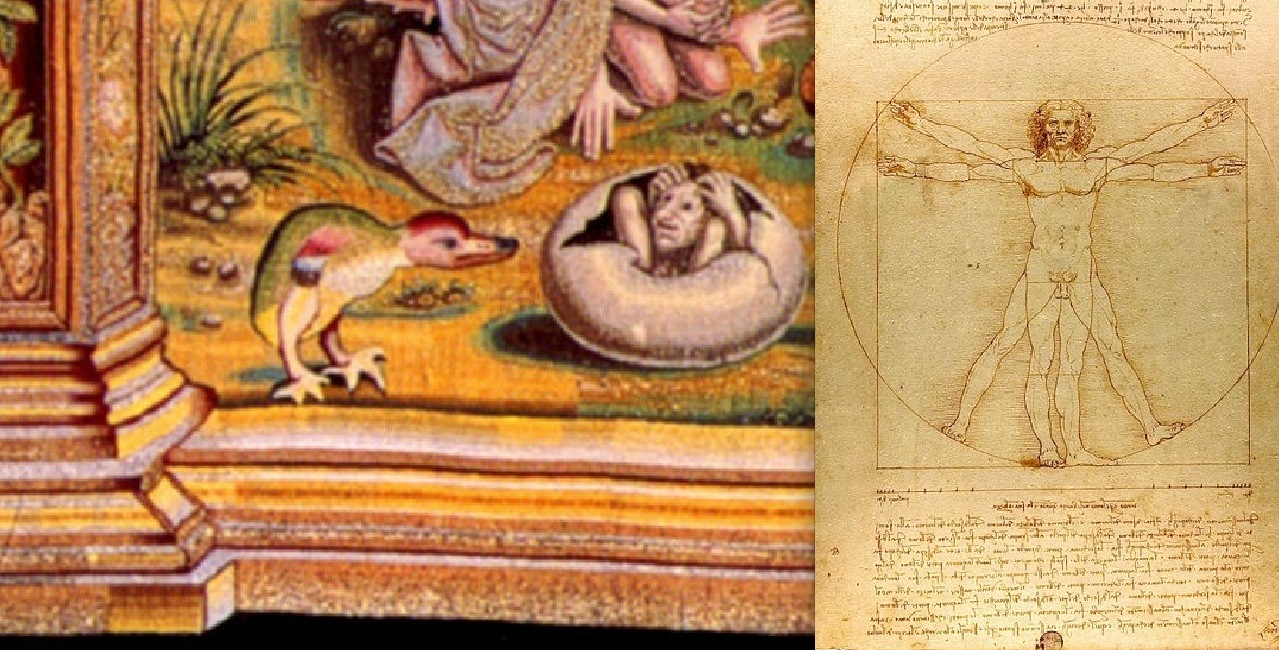
This is not by Leonardo (continued) or champ fleury versus desert


But still, why make fun of Leonardo da Vinci just because his caption on a drawing was a little imprecise? The problem may have been that another favorite of François I was Geoffroy Tory, who wrote a book on typography, Champ Fleury, in 1529 and then in 1530 became the French king’s publisher, and who was an admirer of Leonardo da Vinci. Did he get the job for his Leonardo da Vinci imitations? His versions of the Vitruvian man were the ones more people would see (even though the Leonardo da Vinci one is more famous now) because they were in a printed book, and they are definitely creepy. The man in the letter “O” is way too much like an execution scene. The Vitruvian man in the tapestry may be hiding in an ink bottle.
Geoffroy Tory’s book also talked about making letters that represent numbers look like pictures of people, which was more in tune with the decorative numbers in some old handwritten manuscripts, from before the invention of printing. In The Garden of Delights/El Jardín de las Delicias, Adam, the Creator, and Eve form a Roman numeral VI standing for the sixth day of creation and 6-flint/tecpatl, sadly backwards in the tapestry. In the Nahuatl chronology, fingers stand for numbers in several places and two people’s hands with five fingers each, forming an X, stand for the number ten, as in 10-flint/tecpatl. (Happy people, in a swimming pool.) It seems that part of the reason the Nahuatl date signs do not look like real ones is that they are partly made to be improvements on Geoffroy Tory’s typography. (Few would argue today that Geoffroy Tory was a better designer than the Italian Aldus Manutius.)
But what does this have to do with Saint Anthony in the desert, the subject of the tapestry? The book about the life of Saint Anthony by Saint Athanasius is cited in virtually everything that has been written about the painting, but it appears that no art historian has ever read it. (The footnotes with editions and page numbers appear to come from research on another artist, Schongauer, and his famous print of Saint Anthony carried up in the air by devils.) But Athanasius insisted that Anthony took a dislike to reading as a child and memorized the Scriptures instead, just by listening carefully to people. The person in the right panel of the Lisbon triptych is Athanasius, who had a beard and always carried a book, and he is there because he is the writer who transmitted the story about Saint Anthony that is shown in the left panel, along with everything else that is known about Saint Anthony.
Saint Anthony was in the desert to get away from a lot of things including books, but it was the Egyptian desert so there were hieroglyphics. One that appears both in the Bosch triptych and in The Garden of Delights/El Jardín de las Delicias is Horapollo’s fish eating fish. It is not in the Saint Anthony tapestry but the tapestry does seem to include a fish eating a person and a person who has caught a fish, and the implication is unclear. Maybe the saint was not preoccupied with "the lawless or abominable" (which was what Horapollo said a fish represented because fish eat fish) or not interested in Egyptian hieroglypics any more than in Latin writing, or maybe the saints and the artists who designed the tapestry knew that Horapollo’s hieroglypics were not real ones. Maybe Hieronymus Bosch thought Horapollo’s hieroglyphics were devils that annoyed the saint.
This leads back to possibly the most interesting thing about all the “Bosch” pictures and the tapestries, which is that they may demonstrate a level of interest in and possibly knowledge of how to interpret hieroglyphs that is not recorded anywhere else. I think it is implied by the fact that Peter Martyr in his Opera Omnia never discussed Egyptian hieroglyphics or Nahuatl hieroglyphics, even though he described Maya writing a little bit. Comparing the omissions in two areas of interest is a little like dividing by zero, but it seems unlikely that he did not notice the similarities in the two writing systems. It might also be that whatever was known about either Nahuatl or Egyptian hieroglyphics may have been regarded as confidential, not for publication. A dozen or so years later the Codex Mendoza included a proper legal certification of the accuracy of its translation and fell into the hands of French pirates, but there was no published handbook for deciphering Nahuatl documents.
Geoffroy Tory’s book title Champ Fleury literally means a field of flowers, so Saint Anthony’s desert was a likely place to put it so long as it was personified by one of the devils bothering the saint. On the other hand, “desert” can sometimes just mean a deserted place and so a desert might be a place with nothing but flowery fields. The word did not always imply that a place was dry. So champ fleury could equal desert.